
How to Mix Floral Curtains with Stripes, Checks, and Rugs
To mix floral curtains with stripes, checks, or a patterned rug, give the patterns different roles: let one lead, connect them with a shared color, and vary their apparent size and contrast. Leave some plain surfaces between them, then judge the combination from the places where you actually sit and enter the room.
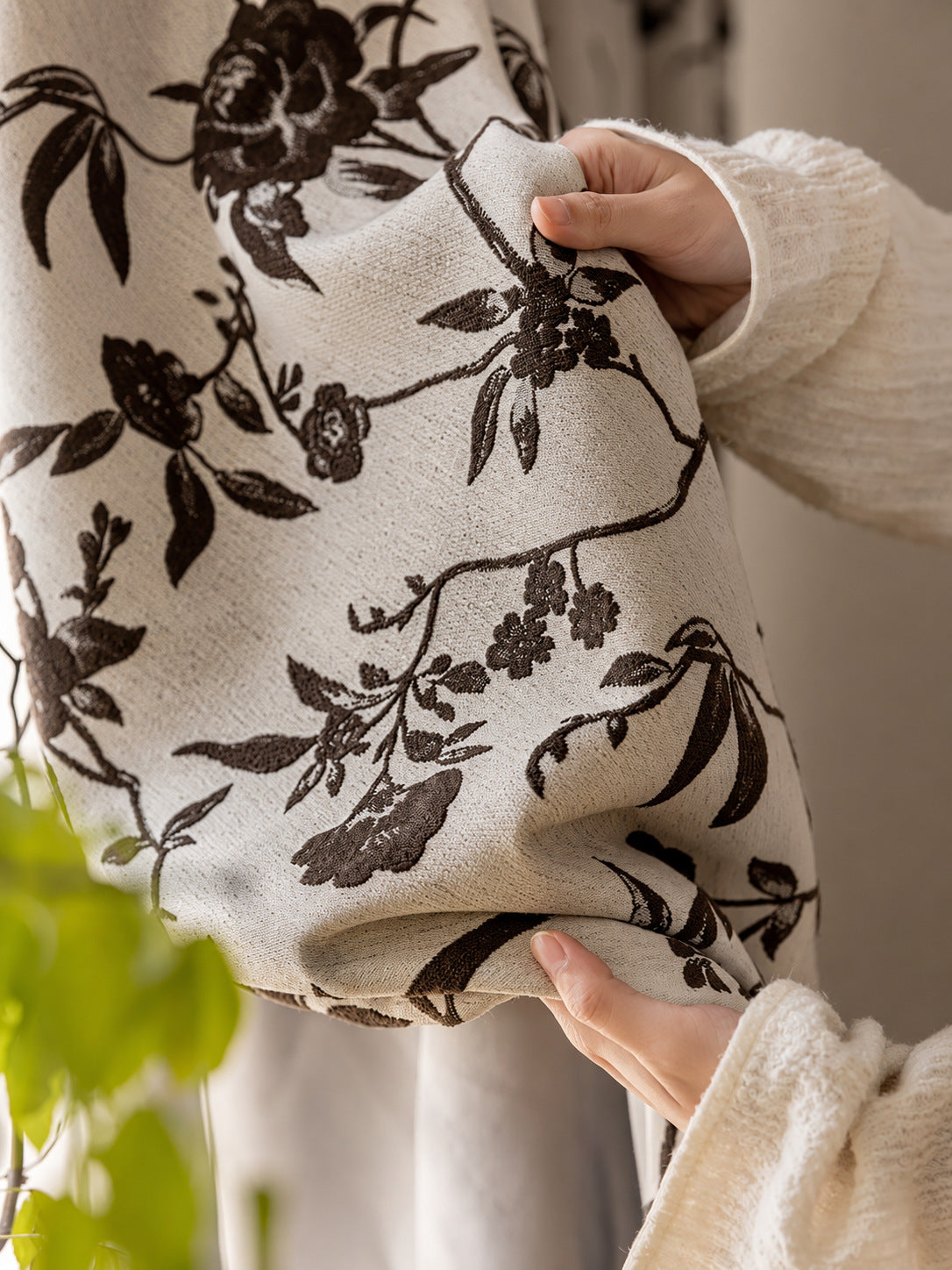
The featured close-up shows dark flowers and branching stems on a light, visibly textured background. Its curved lines suggest a useful starting point for pairing: a simpler geometric pattern can provide a different rhythm while a repeated background or accent color connects the two. You do not need every fabric to match, and you do not need to add another pattern if the room already feels complete.
Choose which pattern should lead
Begin with the piece you want to notice first. That might be the floral window, a favorite rug, or patterned upholstery you are keeping. This decision helps you compare new pieces against something specific instead of collecting several designs that each demand attention.
If the curtains are the lead, start with a quieter stripe or small check on an accent pillow. If an existing rug is the lead, consider floral curtains whose colors feel related and whose contrast does not overwhelm the floor. A large surface can still play a supporting role when its pattern is subtle.
Walk to the doorway and look at the whole room. If your eye jumps between the window, sofa, and rug without finding a comfortable resting point, remove one competing piece before changing everything.
Build a color connection without matching everything
Choose a color that appears in both patterns. With a light-ground, dark floral, the link could be the pale background, the dark motif, or a quieter intermediate tone. It only needs to be recognizable when the pieces sit together.
Compare the actual backgrounds as well as the decorative marks. A creamy stripe and a cool white floral may feel more different beside each other than their dark lines suggest. Try them near the window and again under the room's evening lighting before deciding whether you enjoy that contrast.
For a room built mainly around cream, beige, and wood, our guide to styling dark floral curtains in a warm neutral room explains how to carry the curtain palette into surrounding furnishings. Here, use that palette as the starting point for a second pattern.
Pair floral curves with a simpler geometric rhythm
Stripes
A stripe gives the eye a repeated straight line beside the flowers' irregular shapes. Try a subdued stripe on a pillow or chair cushion before committing to a larger striped surface. Look at how clearly the stripe reads from across the room; a fine line may blend into a near-solid impression at that distance.
Keep the comparison visual rather than relying on a label such as “thin stripe.” A high-contrast narrow stripe can look quite lively, while a wider stripe in closely related colors may feel restrained.
Checks and grids
A check can work with a floral when the two have a clear difference in visual density. Place the samples together and notice the spaces between the marks. If both create a similarly busy field, try a softer check or a different apparent scale.
There is no need to make the square shapes align with the floral branches. Their shared color and different rhythms can provide enough connection. Avoid adding extra coordinating items until you have seen the first pairing in the room.
Let the rug connect the window to the seating
Look at the rug as a broad field of color and pattern. A faded-looking design, an open geometric layout, and a dense floral rug can each create a different relationship with the same curtains. Choose the one that supports your preferred focal point.
If the rug is already strongly patterned, begin with plain upholstery and bring the curtain sample close to the rug. Then stand back to see whether the window and floor feel connected. A repeated color can help, but the amount of contrast matters too.
For a rug you are keeping, work outward from it. Lay out the curtain option with your sofa fabric and one accent textile. This small group is more useful than comparing a curtain with a rug photograph on a separate screen, where lighting and color reproduction may differ.
Test the combination as a room, not a stack of swatches
Start with the Luxvelum custom curtains collection and save the exact designs you are considering. If a suitable sample is available, the LUXVELUM Curtain Fabric Swatches listing is a useful next stop. Confirm that the sample corresponds to your selected curtain option.
Place the curtain sample near the window, the accent textile near the seating, and the rug in its usual position. Review them together in daylight and evening lighting. The guide to evaluating curtain fabric samples at home offers a fuller process for comparing color and surface appearance.
A small sample can help you compare a palette, but it cannot show the full room effect of an entire floral panel. Use current hanging photographs to understand the broader design, and consider both open and closed curtain views. Gathered fabric can bring dark motifs closer together than a flat sample does.
Common pattern-mixing mistakes
- Choosing everything at the same visual intensity. Reduce the contrast or prominence of one supporting pattern so the room has a clearer focus.
- Matching only the darkest color. Check whether the background colors work together, especially across large surfaces.
- Adding too many accent pieces at once. Introduce one patterned item, live with the arrangement, and add another only if it improves the room.
- Forgetting plain surfaces. A solid sofa, simple throw, or clear stretch of wall can give neighboring patterns room to be appreciated.
- Approving the combination only at close range. Check the doorway and your usual seat; those views reveal relationships a swatch pile cannot.
Frequently asked questions
Can floral curtains work with striped pillows?
Yes. Start with a shared color and a stripe that plays a supporting role. Compare the pieces in the room, then step back to check whether the stripe remains distinct without competing with the floral.
Can I use a floral rug with floral curtains?
You can, particularly if one design is quieter or reads at a noticeably different scale. Test the pairing with plain upholstery first. If both florals dominate the view, simplify one of the large surfaces or reduce the contrast elsewhere.
Do all the patterns need the same background color?
No. Related backgrounds can make coordination easier, but different backgrounds can also work if you like the result in the room's lighting. A shared accent color is another way to connect them.
How many patterns should I use in one room?
There is no fixed number that suits every room. Begin with the existing large pieces, choose a lead pattern, and add one supporting pattern at a time. Stop when the arrangement feels balanced from your normal viewing positions.


