
How to Plan Curtains for Windows on Adjacent Walls
To plan curtains for windows on adjacent walls, treat each wall as its own measured run, then decide what happens where the two treatments approach the corner. Map where the panels will rest when open, check that each window remains accessible, and confirm the hardware arrangement before ordering fabric. Matching curtains can unite the view even when the two sides need different panel arrangements.
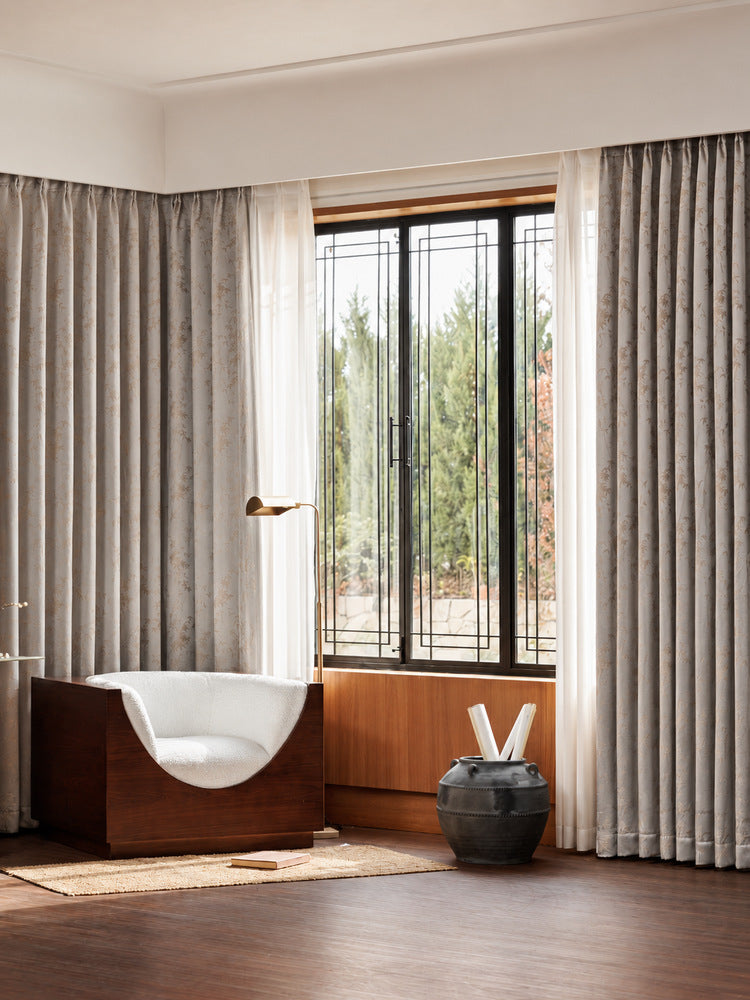
The featured photograph shows pale bamboo-pattern curtains extending across two adjoining wall planes, with white sheer fabric beside the central window. A light upper border carries the eye around the room, while the dark window frame and warm wood keep the opening distinct. The image suggests a coordinated corner composition; it does not reveal the concealed hardware or prove that a panel can travel around the turn.
Start with a sketch of both walls
Draw the corner from above and label the walls A and B. Add each opening, the wall between its trim and the corner, and the space beyond its opposite edge. Include furniture that will stay, plus window handles and other projections. A simple sketch is more useful than one combined width because it shows where the treatment changes direction.
Take a photograph looking toward each wall and another showing the corner. Use these alongside your sketch when discussing the installation. Keep the raw opening measurements separate from the planned hardware spans. The custom curtain measuring guide explains the hanging-point and finished-coverage references needed for the final order.
Decide where the open panels should rest
The corner can look spacious when the curtains are closed yet become crowded when fabric gathers there. Plan the open position before choosing a symmetrical arrangement. Draw an arrow for each panel's intended movement and a shaded area where its folds should rest. Check this arrangement from the doorway and the seat you use most.
Keep the corner visually open
Where the site and selected hardware permit, consider gathering fabric toward the outer ends of the two wall runs. This can leave the junction easier to see. It may require different opening directions on the two walls, so confirm the panel and hardware configuration rather than assuming a standard pair will produce the result.
Use the corner as a resting area
If you prefer fabric at the junction, draw both gathered stacks on the same sketch. Review whether they would crowd each other, cover nearby controls, or make a window difficult to reach. Ask for an assessment using the exact fabric, header, hardware, and site dimensions. A flat fabric width alone cannot tell you how much room a gathered curtain will occupy.
Choose the hardware arrangement deliberately
Two separate rods or tracks and a system designed to turn a corner create different operating plans. With separate runs, each treatment has its own endpoints. A continuous-looking upper line can still conceal separate hardware. With a turning system, compatibility depends on the actual track, corner components, carriers, and header.
Do not assume a bendable track, a corner connector, or matching rod finishes will allow the selected curtain to move through the junction. Have the supplier or installer confirm the intended travel path and mounting requirements for the exact system. If that detail remains unresolved, settle it before submitting curtain dimensions.
For a layered arrangement, also map the sheer and outer curtain separately. Draw where each layer ends and gathers at the corner. Our guide to layering sheer and room-darkening curtains covers the broader layer choices; the corner still needs its own clearance review.
Coordinate the two walls without copying every dimension
A shared fabric, header style, and considered upper line can help the treatments read together. Matching appearance does not require identical panel widths. One wall may have a larger opening, more room at its outer end, or a different obstacle. Let those conditions shape the operating plan.
Review the lower edges across both walls, too. Record the actual drop readings for each hanging position and note any floor variation. Do not copy a measurement from one wall to the other because the photograph looks level. Decide the desired visual endpoint, then confirm how the chosen header and order form define the finished length.
Check the corner in everyday use
Before ordering, mark the proposed hardware endpoints and gathering areas with removable markers suitable for the surface. Keep these as planning references, not substitutes for an installation assessment. Walk through a normal morning: approach each window, reach its controls, and trace where the curtain's leading edge would move.
Next, review the furniture. In the photograph, the wood chair sits in front of the curtain area, making access behind it a useful question for a real room. Check whether your own chair, table, or lamp would require moving every time you open the panels. Adjust the layout before treating an attractive closed view as a finished plan.
Confirm the pictured fabric and the order contents
The current Bamboo Rhythm Song-Inspired Jacquard Custom Curtain listing includes this room photograph. Its listing identifies the curtain as sold by the panel and states that rods, tracks, and sheer panels are not included. Build a separate list for each wall and each layer rather than assuming the photograph represents one complete package.
The bamboo motif can connect the two wall planes visually, but the picture does not establish privacy, light control, or hardware compatibility. Review those requirements for the exact selections. When comparing alternatives in the Luxvelum custom curtains collection, keep your corner sketch beside the product information so the fabric choice remains connected to a workable installation.
Common mistakes with adjoining window walls
- Ordering from one combined width. Record the separate wall runs, endpoints, and corner relationship.
- Sending both stacks into the same space without checking. Review the two open positions together.
- Reading concealed hardware from a room photo. Confirm the exact components and permitted curtain movement.
- Copying the first wall's drop. Measure each hanging position and retain any differences.
- Assuming a photographed sheer is included. Check the contents of each product and order each required element.
Frequently asked questions
Do curtains on adjacent walls need to match?
No. Matching fabric is one way to connect them visually, while different fabrics can distinguish separate areas. In either case, review both walls together and keep the panel movement practical.
Should both curtains gather in the corner?
Only if the available space and selected installation support that arrangement. Sketch both stacks together and check access. Gathering toward the outer ends is another possibility to discuss for your site.
Can one curtain travel around the corner?
Confirm that with the supplier or installer for the exact hardware and header. A continuous decorative border or a corner-shaped installation in a photograph does not establish a continuous travel path.
Can I use the same measurements for both walls?
Measure them separately. Similar-looking openings can have different surrounding space, hanging points, and floor relationships. Translate each plan into order dimensions only after the hardware and product instructions are clear.


