How to Layer Sheer and Room-Darkening Curtains
Direct answer: For most windows, place the sheer curtain closer to the glass and the room-darkening curtain toward the room, using separate tracks or rods so each layer can move independently. The sheer layer softens daylight, while the room-darkening layer adds stronger light control and privacy when closed. Choose both layers for compatible dimensions, headers, hardware, and movement before ordering.
Why layer sheer and room-darkening curtains?
A layered window gives you more control than either curtain can provide alone. During the day, you can leave the sheer closed to diffuse bright light while keeping the heavier panel open. In the evening, closing the room-darkening layer adds privacy and reduces more incoming light. The result is a window treatment that can adapt as the room, light, and activity change.
The terms still matter. A sheer or light-filtering curtain is not a privacy guarantee after dark, especially when interior lights are on. A room-darkening curtain reduces incoming light but does not promise the same performance as a blackout treatment. For a fuller explanation, see blackout vs. room-darkening vs. light-filtering window treatments.
Choose the role of each curtain layer
Use the sheer as the daytime layer
The inner layer usually handles soft daylight and a lighter visual mood. A sheer can reduce harsh contrast and create an airy background without making the room feel closed off. Browse the sheer curtain collection for options designed around this lighter role.
The current LuxVelum Hera Sheer Curtains listing describes Hera as a made-to-measure, light-filtering polyester voile. Those details apply to Hera specifically, not to every sheer fabric. Its purpose in this pairing is to filter light, not to act as a room-darkening or blackout curtain.
Use the room-darkening curtain as the closing layer
The outer layer usually provides greater light control, evening privacy, visual weight, and a finished frame around the window. When this layer is open, it can sit at the sides as a decorative feature. When it is closed, it becomes the more substantial light-control layer.
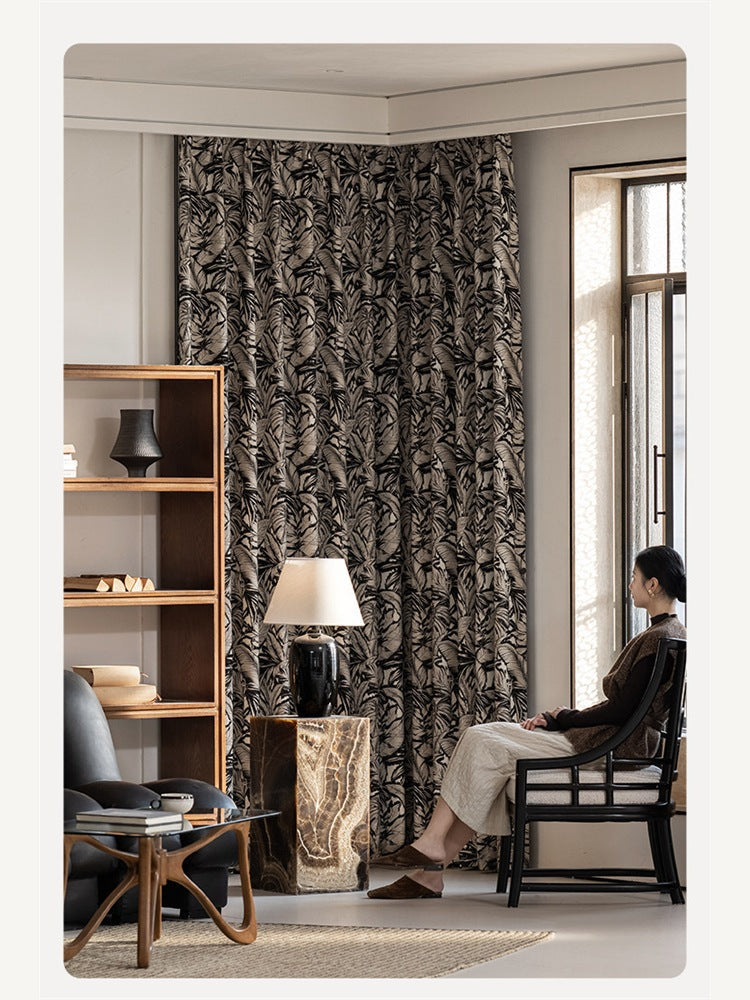
For example, the current Bali Botanica Black Yarn-Dyed Jacquard Custom Curtain listing describes a dense polyester jacquard with a structured drape and room-darkening light control. The current Maupassant Reversible Chenille Jacquard Room-Darkening Curtain listing describes a reversible chenille jacquard with a substantial drape and room-darkening design. These are product-specific examples; neither listing promises complete blackout.
Plan the layer order
Start with sheer inside and room-darkening outside
The most practical arrangement places the sheer nearest the window and the room-darkening panel nearest the room. This keeps the soft daylight layer available when the heavier curtain is open. It also lets the decorative face of the outer curtain remain prominent from inside the room.
Reverse the order only for a clear design reason
Some rooms use the heavier curtain closer to the glass and the sheer toward the room for a soft decorative veil. That can create a distinctive look, but it changes how the layers stack and how easily you reach the curtain you want to move. Test the intended opening sequence before choosing this arrangement.
Decide how the panels should move
Independent movement is the main advantage of layering. Decide whether both layers will open from the center, draw to one side, or use a different arrangement. Make sure handles, cords, wands, or hand-drawn edges remain accessible without pulling one curtain through the other.
Select compatible hardware
Use separate channels for independent control
A double rod, paired track, or compatible layered system gives each curtain its own path. The hardware must support the combined curtain weight and allow enough clearance so folds, headers, and decorative details do not rub. Confirm support requirements against the chosen hardware rather than assuming every double rod fits every fabric.
Match headers to the hardware
Header style affects how a curtain hangs, stacks, and moves. Choose headers that work with the intended rod or track and that do not compete for the same space. If the outer panel has a fuller or more structured heading, check that it can travel without catching the sheer behind it.
Check projection and nearby obstacles
Window handles, trim, radiators, furniture, and deep sills can affect the path of layered curtains. Look at the full area around the window with both layers imagined open and closed. Hardware should hold the curtains clear of obstacles while keeping the layers visually aligned.
Coordinate color, pattern, and texture
Let one layer lead
A simple pairing usually gives one curtain the stronger visual role. A patterned room-darkening curtain can lead while a quiet sheer supports it. If the outer curtain is solid and restrained, a sheer with subtle texture can add depth without making the window feel busy.
Compare the fabrics in changing light
Colors and patterns can look different in direct daylight, indirect light, and evening illumination. Compare the proposed layers together if samples are available. Look at the combination from inside the room with the sheer closed, both layers closed, and both layers stacked to the side.
Keep undertones intentional
Warm neutrals, cool grays, crisp whites, and creamy ivories can shift the mood of the pairing. They do not need to match exactly, but they should look deliberate beside the wall color, flooring, and major furniture. Repeating one undertone elsewhere in the room can make the layered window feel connected to the larger design.
Measure the complete layered system
Measure the window and mounting area first
Do not order one layer and assume the second can copy it later. Record the window, mounting surface, trim, nearby obstacles, and available stacking space as one system. The guide to measuring for custom curtains explains the planning sequence without treating every installation as identical.
Plan coverage for each layer
The sheer and room-darkening curtains may share a visual bottom line, but they do not always need identical fullness or stacking behavior. Consider how each fabric drapes, how much of the window it should cover when closed, and where it should rest when open. Review curtain fullness before finalizing panel width and quantity.
Confirm finished relationships
Check how the headers align, whether the outer curtain conceals the inner hardware, and whether the hems look intentional together. Small differences can be part of the design, but accidental misalignment is harder to correct after custom curtains are made.
Install and test the layers step by step
Confirm the mounting surface and hardware
Before hanging fabric, verify that the mounting method and fasteners are appropriate for the surface and the combined load. Follow the hardware manufacturer's instructions. If the mounting condition is uncertain, use a qualified installer rather than improvising.
Hang the inner layer and test its travel
Install the channel nearest the window, hang the sheer, and move it through its full path. Check that it clears handles and trim, stacks where planned, and hangs without being forced against the glass or nearby obstacles.
Add the outer layer and test every position
Hang the room-darkening curtain, then test the system with the sheer closed, the outer curtain closed, both open, and each layer moving independently. Look for rubbing, snagging, blocked access, uneven stacking, or hardware flex before treating the installation as complete.
Adjust the dressing, not the product claims
Arrange the folds and side stacks so both curtains hang cleanly. Remember that dressing a panel more carefully can improve its appearance, but it does not turn a sheer into room-darkening fabric or a room-darkening curtain into blackout fabric.
Common layering mistakes to avoid
Expecting a sheer to provide nighttime privacy
Interior lighting can make silhouettes more visible through a sheer after dark. Close the room-darkening layer when greater evening privacy is needed.
Using one channel for two independently moving layers
If both curtains need separate control, they need compatible separate paths. Crowding them onto hardware designed for one layer can restrict movement and create uneven stacking.
Ordering before checking the combined depth
Layering adds fabric, headers, and hardware projection. Ignoring the full assembly can lead to rubbing, blocked handles, or a curtain that cannot stack where expected.
Treating room-darkening and blackout as synonyms
Room-darkening describes stronger light reduction than a sheer or light-filtering layer, but it is not a promise of complete blackout. Product construction, curtain coverage, fullness, installation, and light around the edges all affect the result.
Repeating every decorative feature
Two bold patterns, competing trims, and multiple strong textures can overwhelm a window. Give one layer priority and use the other to support its color, texture, or function.
Frequently asked questions
Do sheer curtains go behind room-darkening curtains?
Usually, yes. Placing the sheer closer to the window and the room-darkening curtain toward the room makes independent daytime and evening control straightforward. A reversed arrangement can work when it serves a specific decorative plan.
Can I use one rod for both curtain layers?
Only if the hardware is specifically designed to give both layers the movement and clearance you need. A double rod or paired track is generally more practical when each curtain should open and close independently.
Will layered room-darkening curtains make a room completely dark?
Not necessarily. A room-darkening outer curtain reduces incoming light, but light can still enter around the curtain or through installation gaps. Choose a true blackout product only when the current product listing clearly identifies it that way.
Should both layers have the same fullness?
Not always. Fabric weight, weave, header, desired folds, and stacking space affect each layer differently. Plan the sheer and room-darkening panels as a coordinated system rather than copying one specification automatically.
How do I choose colors for layered curtains?
Choose one layer to lead and let the other support it. Compare both fabrics in the room's daytime and evening light, and check their undertones beside walls, flooring, and furniture before ordering.
A practical final check
Before placing an order, confirm the role of each curtain, the layer order, separate movement, compatible headers and hardware, mounting conditions, stacking space, finished alignment, and exact product light-control terms. A successful layered window is not just two attractive fabrics; it is a coordinated system that remains easy to use throughout the day.