How to Style a Wide Patterned Curtain Wall
To keep a wide patterned curtain wall from overwhelming a room, give it a clear role as the main decorative surface, leave nearby areas visually quiet, and review the composition with the panels both open and closed. Choose furniture outlines, accessories, and background colors around the amount of pattern you will actually see each day.
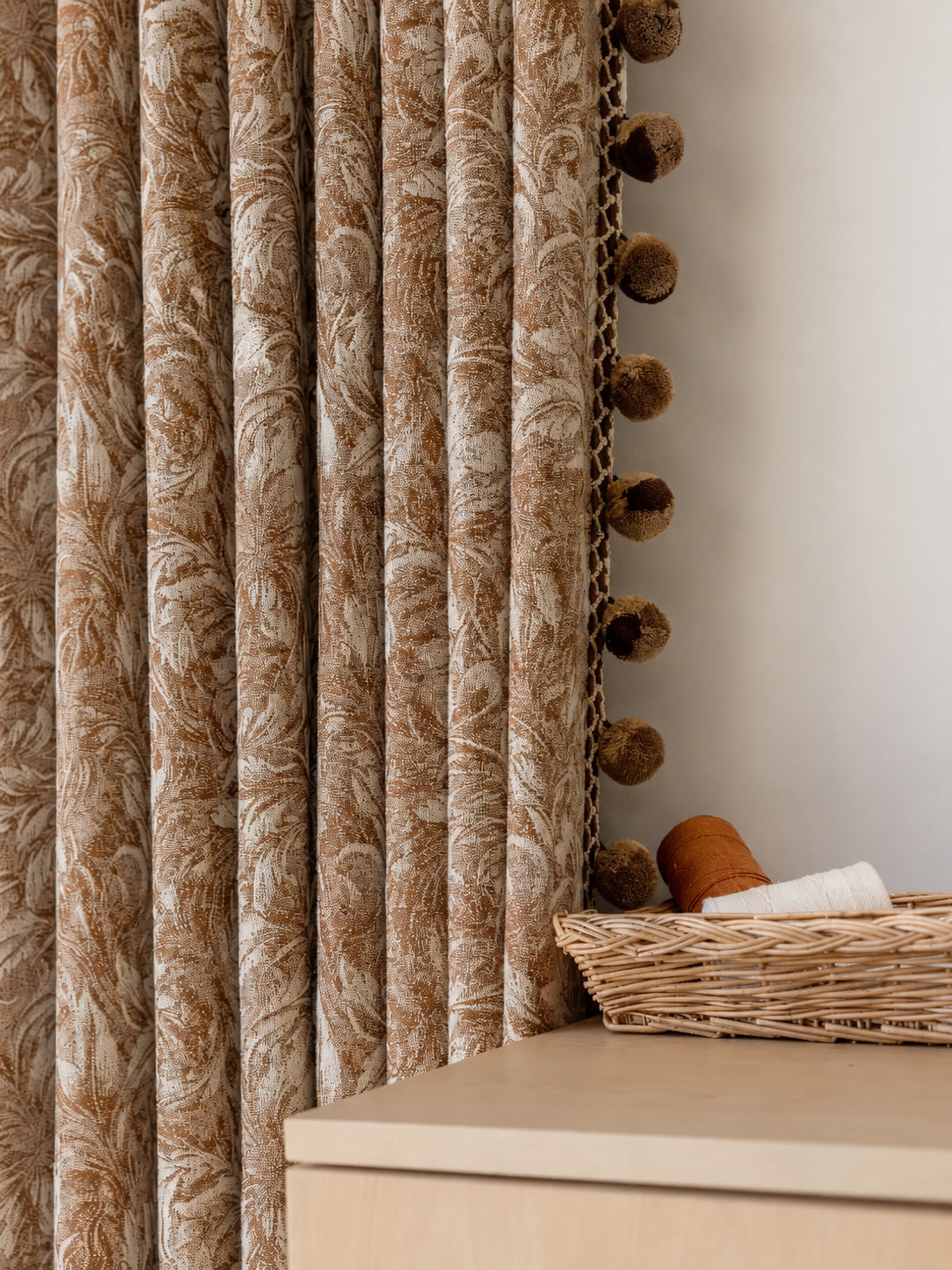
The featured photograph shows brown curtains covered with pale leafy motifs, extending across most of the visible wall. A narrow opening reveals a white sheer behind them, while plain ceiling and floor areas frame the fabric. The useful styling lesson is the balance between a large patterned surface and simple surroundings. The photograph does not establish fabric composition, curtain dimensions, or light-control performance.
Decide whether the curtain wall is the backdrop or the focal point
A curtain that covers a broad area behaves differently from a small decorative accent. Even a muted botanical design can become prominent when repeated across an entire view. Before choosing more furnishings, decide how much attention you want that surface to receive.
If the curtain is the focal point, let its pattern provide most of the room's decoration. A plain sofa, a simple table, and a restrained arrangement of objects can give the fabric room to stand out. If a painting or an architectural feature should remain the focus, compare a quieter curtain option or a color with less contrast between motif and background.
Judge this from the doorway and from your usual seat. A close-up may emphasize individual leaves, while the view across the room may read as an overall brown field. Both impressions matter, but the everyday view should guide the larger composition.
Plan for three everyday curtain positions
Fully closed: review the largest patterned surface
Imagine the panels drawn across the entire intended span. This is when the design occupies the most continuous area. Look at everything directly in front of it: chair backs, lamps, shelving, and decorative objects. If several outlines disappear against the fabric, simplify the grouping or introduce a plain surface that separates them.
Fully open: review the side stacks
Gathered curtains move the pattern toward the sides and expose more of the window or the layer behind it. A room that feels balanced when closed may look crowded beside one stack when open. Check whether a tall plant, floor lamp, or cabinet competes with that concentrated fabric area. Moving an accessory can be more useful than adding another one.
Partly open: review the opening you use most
The photograph shows a narrow bright opening between patterned panels. In your room, the normal daytime position might reveal a much broader section. Consider whether the opening looks intentional from the main seat and whether the fabric can move without brushing furniture. The goal is a composition that works in use, without needing constant rearrangement.
Keep some nearby surfaces free of pattern
A wide curtain wall benefits from places where the eye can rest. Those areas might be a plain upholstered chair, a clear stretch of floor, an undecorated side wall, or a simple ceiling line. They do not all need to be white. A solid warm gray, cream, or deeper brown can provide a calm neighbor if it suits the room.
Start with the surfaces immediately beside and in front of the curtain. If both the upholstery and rug have busy designs, decide which pattern should lead and which can recede. You do not need to replace everything at once. Removing a patterned throw or reducing objects on a nearby shelf can reveal whether the curtain itself needs changing.
Browse Luxvelum custom curtains with this balance in mind. Compare the whole hanging view of each design, rather than choosing solely from a tightly cropped fabric detail.
Use clear furniture shapes against the fabric
Simple silhouettes are easier to read against a detailed backdrop. Consider the outline of a chair, the shape of a lampshade, or the edge of a console table before adding decorative finishes. A piece does not have to be minimalist; it needs enough visual separation to remain recognizable from your normal viewing position.
For example, a plain cream chair can create a distinct shape against brown botanical curtains. A dark, open-frame chair may give a lighter impression, but its thin lines could become less visible against the same motif. Try the actual piece in place before deciding. Color alone cannot predict how its outline will read.
Keep practical access in the layout. Leave room to reach the leading curtain edge and operate the treatment as designed. Avoid positioning a table where opening the panel requires shifting the table every morning.
Choose one small color connection
Repeat a curtain color in a limited detail, such as a cushion, a ceramic bowl, or a lampshade. That connection can make the curtain feel part of the room without spreading the same botanical motif onto every surface.
Use the actual color you see at home as the reference. Brown can appear warmer or cooler beside different walls and under different lighting. Check an available sample against the objects that will stay in the room. The guide to evaluating curtain fabric samples at home provides a practical comparison process. A small sample helps with color and surface appearance; it cannot preview a complete curtain wall.
Separate the visual plan from the order dimensions
Once the composition feels right, confirm how the chosen treatment will cover the intended area. The visible wall, window opening, hardware span, and product order fields are separate references. A photograph of a broad curtain installation cannot tell you which width to enter for your own project.
Use the custom curtain measuring guide to record the site and hanging references. Then consult the curtain fullness guide when translating the coverage plan through the selected header and product instructions. Avoid adding an allowance that the ordering system already includes.
Common styling mistakes
- Decorating for only the closed view. Review the open stacks and the everyday partial opening as well.
- Repeating the botanical motif everywhere. Try a small color connection before introducing more patterned accessories.
- Filling every plain area. Keep some quiet surfaces around the large fabric backdrop.
- Choosing furniture only by color. Check its outline against the pattern from across the room.
- Copying the photograph's apparent proportions. Measure your own installation and use the exact product definitions.
Frequently asked questions
Can patterned curtains cover most of a wall?
They can be a deliberate decorative choice when the installation is suitable. Review the complete patterned area, the open stacks, and neighboring furniture before deciding. Confirm the hardware and coverage plan for the actual site.
Do wide patterned curtains need plain furniture?
Plain furniture is one useful starting point. Patterned furniture can also work if the combination remains clear from the main viewing positions. Introduce additional designs gradually and keep some surrounding areas quiet.
Should the curtain color match the walls?
An exact match is optional. A related background color can create a gentle transition, while a stronger difference can make the curtain more prominent. Compare samples beside the actual wall before choosing.
Will a white sheer make a brown curtain wall feel lighter?
A visible white layer can add a pale area when the brown panels are open. The effect depends on how much of that layer you expose and on the room's lighting. It does not establish the sheer's privacy or the outer curtain's light-control performance.
Build the room around the curtain position you use most, then check the other positions before ordering. A broad patterned backdrop feels more considered when its surroundings, furniture outlines, and daily movement have all been planned together.