Curtains vs. Shades vs. Blinds: Which Is Right for Your Home?
Short answer: Choose curtains for visible fabric, softness, and decorative scale. Choose shades for compact coverage that raises and lowers as one continuous treatment. Choose blinds for adjustable slats that redirect daylight and change privacy without fully uncovering the window. If two options are close, decide whether you value atmosphere, a clean window profile, or fine light adjustment most.
Curtains, shades, and blinds are three different structures, not interchangeable style labels. The structure determines how the treatment moves, how much visual space it occupies, and how you adjust coverage during the day. Material then determines opacity, texture, care, and other product-specific details.
This guide is a focused category comparison. For the broader process of setting priorities, measuring, and confirming specifications, use Luxvelum's complete guide to custom window treatments.
Comparison table: curtains vs. shades vs. blinds
| Decision factor | Curtains | Shades | Blinds |
|---|---|---|---|
| Basic structure | Fabric panels on a rod or track | Continuous material that rolls, folds, pleats, or stacks | Slats that tilt and can usually raise |
| Everyday adjustment | Open or close panels | Raise or lower coverage | Tilt slats, then raise when desired |
| Visual presence | Broad, soft, and decorative | Contained within or near the opening | Crisp, linear, and structured |
| Distinct advantage | Adds fabric scale and movement | Keeps coverage compact | Redirects light without fully opening |
| Important trade-off | Uses wall and floor-adjacent space | Most styles offer less directional adjustment | Slats need regular dusting and can show light lines |
No column automatically delivers blackout, nighttime privacy, or easy care. Those outcomes depend on the exact material, construction, fit, and installation. A light-filtering shade and a blackout shade share a category but not the same performance.
Three structures, three different ways to use a window
Curtains: move fabric across the opening
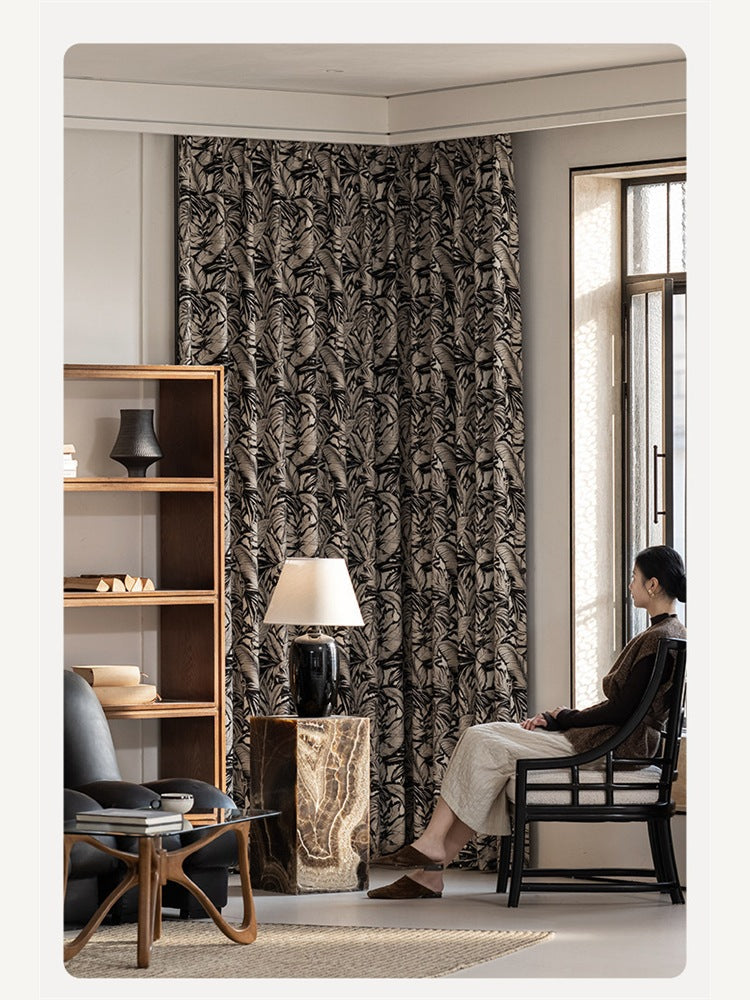
Curtains hang in vertical panels and travel sideways along a rod or track. Their width, length, fullness, header, and material make them part of the room's composition, not just a covering for the glass. Closed panels form a broad fabric surface; open panels frame the window and can make it feel wider or taller.
Custom curtains are the clearest choice when you want texture, movement, or a strong decorative frame. They also make layering intuitive because two fabric treatments can perform separate jobs. A sheer can soften daylight while a more opaque panel is reserved for evening privacy.
Do not infer light control from color or weight. The Bali Botanica Black Yarn-Dyed Jacquard Custom Curtain, for example, is currently described as room-darkening rather than blackout. Its performance still depends on curtain dimensions, fullness, lining, installation, and light around the edges.
Shades: move one treatment vertically
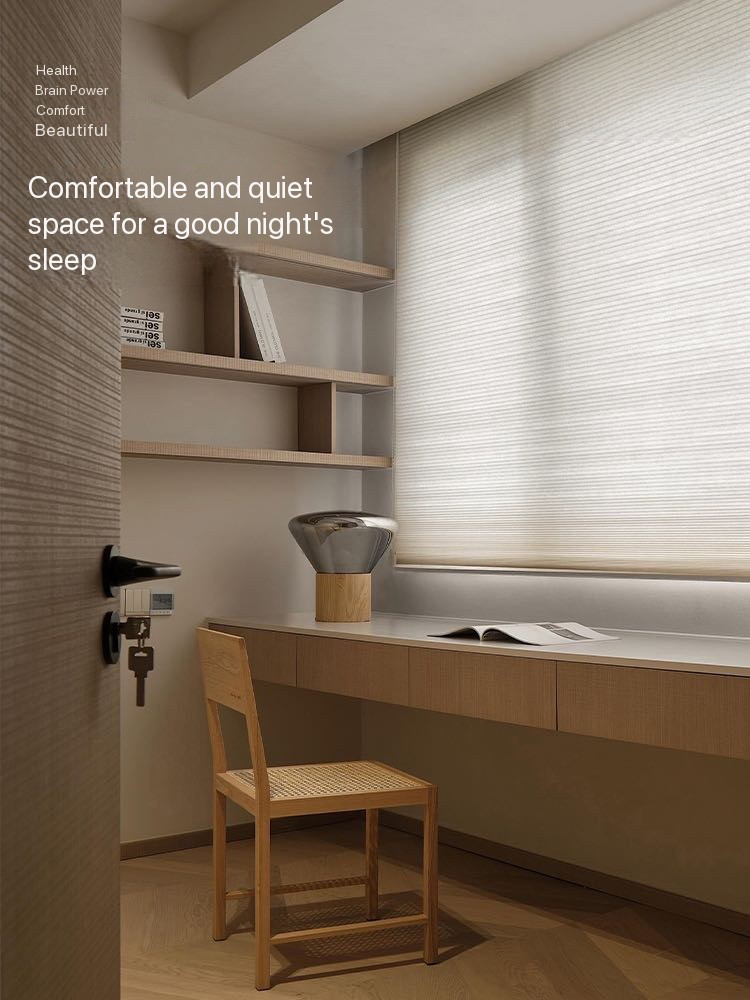
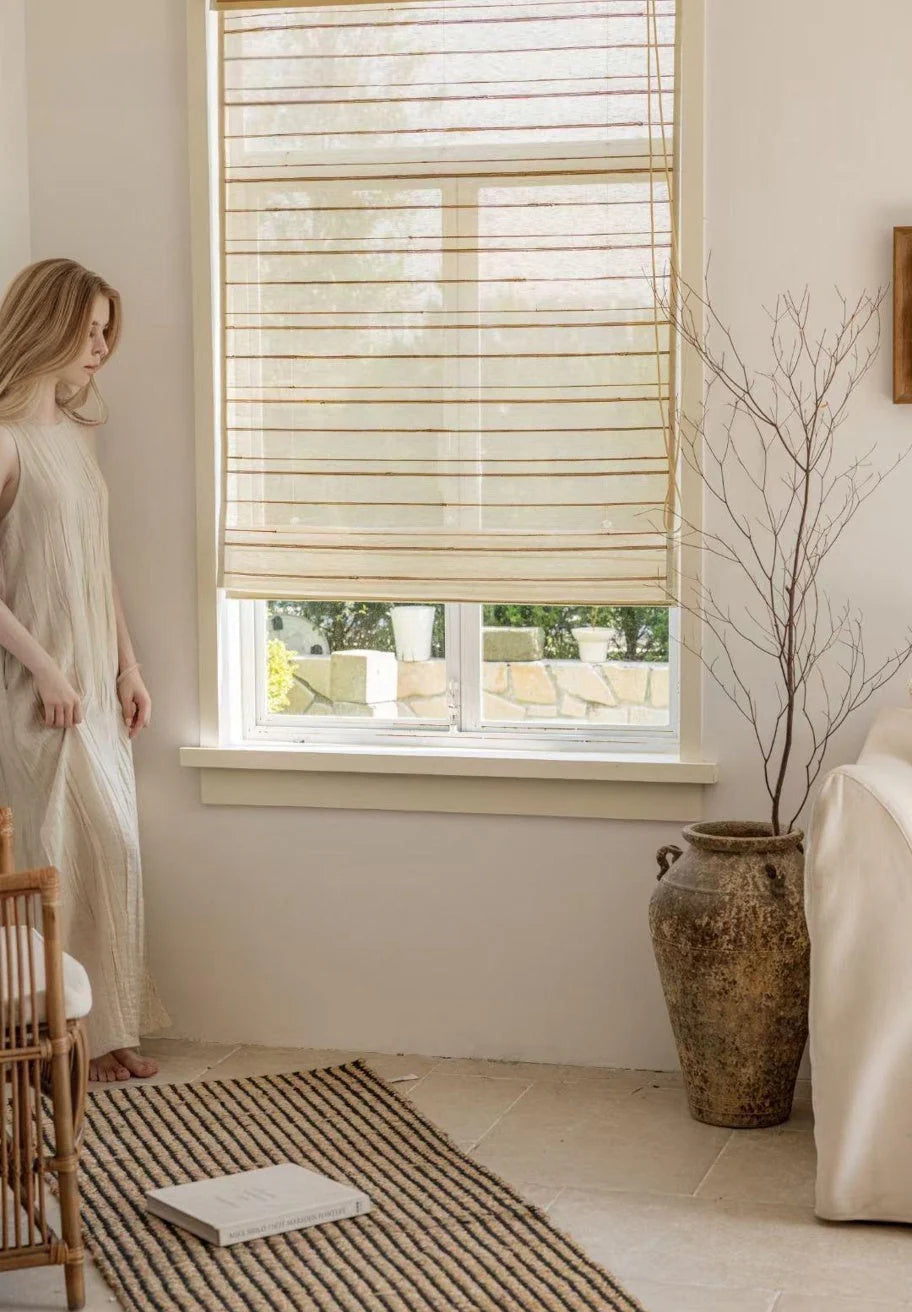
Shades cover the window with a continuous piece of material or a connected fabric structure. Roller shades wind at the top, cellular shades compress their pleated cells, and Roman shades form horizontal folds. Their shared advantage is a compact footprint: when raised, they remain concentrated around the window rather than stacking beside it.
Explore Luxvelum's shades and blinds collection when you want coverage to feel contained. Within the shade family, choose the structure before choosing color. A roller shade creates a flat, minimal plane. A cellular shade has a pleated profile. A Roman shade brings visible fabric folds. Each exact material has its own opacity and care requirements.
Blinds: tilt slats before deciding whether to raise them
Blinds use repeated horizontal slats. Their defining feature is tilt: you can change the angle of incoming light and sightlines without choosing only between fully covered and fully open. That makes blinds useful where the sun, view, or privacy need changes during the day. For a focused comparison of slat control, shade structures, mounting, and upkeep, read our blinds versus shades guide.
Slat material changes the impression and care profile. Aluminum has a fine, architectural line; wood adds natural variation and warmth; faux wood provides a different material choice with a similar slatted geometry. Compare Luxvelum's Venetian blinds and wood blinds, then verify the construction and care guidance on the exact product page.
Head-to-head decision 1: softness or a contained profile?
Choose curtains when the window should shape the room
Curtains can extend beyond the trim and down the wall, so they influence the perceived height and width of the window. That added fabric can balance large furniture, soften hard finishes, and introduce pattern or texture at a useful scale. The trade-off is physical presence: panels need stacking space and must stay clear of heat sources, furniture, counters, and walkways.
Choose shades when the architecture should stay visually quiet
A shade stays close to the opening and avoids fabric pooling or stacking at the sides. It can preserve trim, leave adjacent wall space open, and fit rooms where full-length panels would feel crowded. Roman shades still provide fabric character, while roller and cellular structures can appear more restrained.
Head-to-head decision 2: full coverage changes or fine adjustment?
Choose shades for simple up-and-down coverage
A shade creates a clear relationship between height and coverage. Lower it when you need more screening; raise it when you want more glass exposed. This is useful when the main choice throughout the day is how much of the window to cover.
Choose blinds to redirect light and sightlines
Tilting slats creates intermediate positions. You can aim daylight away from a screen, reduce a direct sightline, or admit light toward the ceiling without fully raising the blind. Closed slats support privacy, but small light lines and edge gaps can remain depending on design and installation.
Head-to-head decision 3: one treatment or a layered system?
Choose one category when one job dominates
A single treatment keeps operation and visual composition simple. A shade may be enough for compact coverage. A blind may be enough for changing glare. Curtains may be enough when decorative softness and panel privacy are the main goals. Confirm the exact opacity before assuming one product solves every light condition.
Layer when you need two different behaviors
Layering is useful when no single structure provides the desired daytime and nighttime experience. Curtains can frame a shade that handles close-to-glass coverage. A sheer curtain can remain closed for softened daylight while a room-darkening curtain closes later. Give each layer a specific job and confirm that hardware, mount depth, and controls do not interfere.
A five-question decision sequence
- Should the treatment become part of the room's decor? Start with curtains for the largest fabric statement, Roman shades for contained fabric, or blinds for a crisp linear look.
- Do you need to redirect daylight while keeping the window covered? Start with blinds if adjustable slats are central to the decision.
- Is space beside or below the window limited? A shade or blind may avoid the side stack and floor-length footprint of curtains.
- Is the desired material sheer, light-filtering, room-darkening, or blackout? Verify that term on the exact product; never assign it from the category alone.
- Does one treatment handle both daytime and nighttime needs? If not, define a two-layer system rather than expecting one material to behave in opposite ways.
Common comparison mistakes
- Comparing category to material: "Curtain" describes a structure, while "blackout" describes light-control performance.
- Calling Roman shades blinds: Roman shades fold as fabric; blinds tilt individual slats.
- Assuming blinds are either open or closed: Their main advantage is the range of tilted positions between those states.
- Choosing before checking clearance: Curtain stacks, shade rolls, blind controls, handles, and trim all require space.
- Using sheer and light-filtering as promises of privacy: Both admit light, and visibility changes when interior lighting becomes brighter than outdoors.
Frequently asked questions
Are shades better than blinds?
Shades are usually better when you want a continuous surface and simple vertical coverage. Blinds are usually better when you want to tilt slats and redirect light without fully raising the treatment. Neither is universally better.
Are curtains better than shades for a living room?
Curtains add more decorative scale and softness; shades preserve more open wall space and keep the treatment near the window. A living room can also combine them when a shade handles coverage and curtains provide the visual frame.
Which option provides blackout?
Blackout is an attribute of a specific material or product, not of curtains, shades, or blinds as entire categories. Even with a blackout material, edge gaps, mount choice, and installation affect final room darkness.
Which option is easiest to clean?
Care depends on material. Blinds expose individual slats to dust; curtain fabrics and shade materials may have product-specific cleaning instructions. Check the exact item's guidance and consider its distance from cooking residue, moisture, pets, and frequent touch.
Can curtains and blinds be used together?
Yes. Blinds can manage changing daylight and sightlines while curtains add softness or another privacy layer. Plan projection, control access, and stacking space so both treatments operate freely.
Choose the structure first, then verify the material
The most useful first question is how you want to operate the window. Move fabric sideways and frame the room with custom curtains; raise one continuous treatment for compact coverage; or tilt slats for fine adjustment. After choosing the structure, verify the exact material's opacity, care, dimensions, mount requirements, and controls in Luxvelum's shades and blinds collection or the relevant product page. Then use the room-by-room window treatment guide to apply those tradeoffs to living spaces, bedrooms, kitchens, offices, and more.