Roman Shades: Soft Fabric Style in a Structured Design
Direct answer: Roman shades combine the softness of fabric with the contained footprint of a shade. When raised, the material gathers into horizontal folds; when lowered, it forms a broad fabric surface across the window. Choose them when you want more textile character than a roller or cellular shade but less side-stacking fabric than curtains. The best result comes from verifying the exact material, light-control behavior, privacy, fold appearance, mount, operation, and measurements before ordering.
“Roman shade” describes how the treatment is constructed and moves. It does not define one opacity level, fabric fiber, privacy result, or mounting method. A light-filtering Roman shade and a blackout Roman shade may share a folded profile while serving very different rooms. Keep the structure and the material specification separate as you compare options.
What makes a Roman shade distinctive?
Fabric rises into visible folds
A Roman shade uses a continuous fabric face that lifts upward and forms horizontal folds. That movement gives the treatment a softer, more layered appearance than a flat roller shade. When lowered, the larger fabric surface can show weave, color, and texture more clearly than a slatted blind.
Softness and structure work together
The fabric supplies softness; the lift system, seams, folds, and lower edge give the treatment structure. A crisp linen-like weave can read as tailored, while a more relaxed textile can feel casual. Product photography is useful for understanding the intended look, but the exact configured material should decide performance claims.
Roman shades compared with other window treatments
Roman shades versus roller shades
A roller shade winds its material around a tube and usually creates a flatter, more minimal plane when lowered. A Roman shade retains visible fold lines and a more textile-forward presence. Choose between them by deciding whether the window should feel streamlined or softly architectural, then verify the available material for the chosen product.
Roman shades versus cellular shades
Cellular shades use pleated fabric layers that form air cells. Roman shades use fabric that gathers into folds instead. Both belong to the shade family, but their profiles, raised stacks, and visual texture differ. The blinds versus shades guide places these structures within the broader category.
Roman shades versus blinds
Blinds use individual slats that tilt to redirect daylight and change sightlines without fully raising the treatment. Roman shades cover the opening with fabric and adjust mainly by moving up or down. Select blinds for slat-by-slat angle control; select Roman shades for a continuous textile surface and folded silhouette.
Roman shades versus curtains
Curtains frame the window from a rod or track and usually stack at one or both sides. Roman shades remain centered on the opening and gather at the top. Roman shades can be useful where you want fabric character without floor-length panels. For the larger category decision, compare curtains, shades, and blinds before choosing a style.
Choose the light-control category precisely
Blackout describes the material, not the fold
A blackout Roman material is designed to block light through its surface. The folded construction alone does not make a shade blackout, and even blackout material does not guarantee a completely dark room. Visible light can remain around the perimeter depending on the mount, hardware, fit, opening, and installation.
Room-darkening is a separate level
Room-darkening material reduces incoming light without being represented as the strongest light-blocking category. It may suit rooms that need a calmer atmosphere but not the same material opacity expected from blackout. Do not substitute the terms when a bedroom or media space has a specific darkness goal.
Light-filtering softens daylight
Light-filtering material allows a softened glow into the room rather than aiming for strong darkness. It can suit living areas, dining rooms, or bedrooms where diffused daylight is welcome. Privacy still needs to be evaluated under daytime and nighttime lighting because filtered light and visual separation are not the same thing.
Sheer remains the most transparent direction
Sheer material is intentionally more transparent than typical light-filtering fabric. It can preserve brightness and a sense of openness, but it provides less visual separation. Use the light-control terminology guide when a product description is unclear.
Evaluate privacy in the conditions that matter
Coverage changes as the shade moves
Raising a Roman shade opens the lower part of the window and gathers fabric above it. Lowering the shade increases coverage across the glass. A partially raised position can balance daylight and coverage, but it also leaves part of the window exposed. Decide which positions you will actually use during the day.
Nighttime lighting changes visibility
A pale or semi-transparent fabric may look private when the outdoors is brighter than the room. After sunset, interior lighting can reverse that relationship. If the window faces a sidewalk, neighboring home, or shared outdoor area, examine a sample from both sides or ask for product-specific guidance before relying on it for privacy.
Edge coverage is distinct from fabric opacity
A fabric may provide satisfactory visual separation while gaps remain beside the treatment. Inside and outside mounts create different coverage relationships. Consider the opening, trim, mounting surface, and desired overlap together rather than treating privacy as a fabric-only decision.
How the current LuxVelum Lumière shade fits
Use the live product facts narrowly
The current LuxVelum Lumière French-Inspired Linen Roman Shades listing describes a linen-like polyester weave with a semi-transparent appearance. Its copy presents the material as softening harsh daylight into a gentler glow. Those facts support a filtered-daylight design direction for this product; they should not be transferred to every item in the Roman shade category.
The listed details support a tailored look
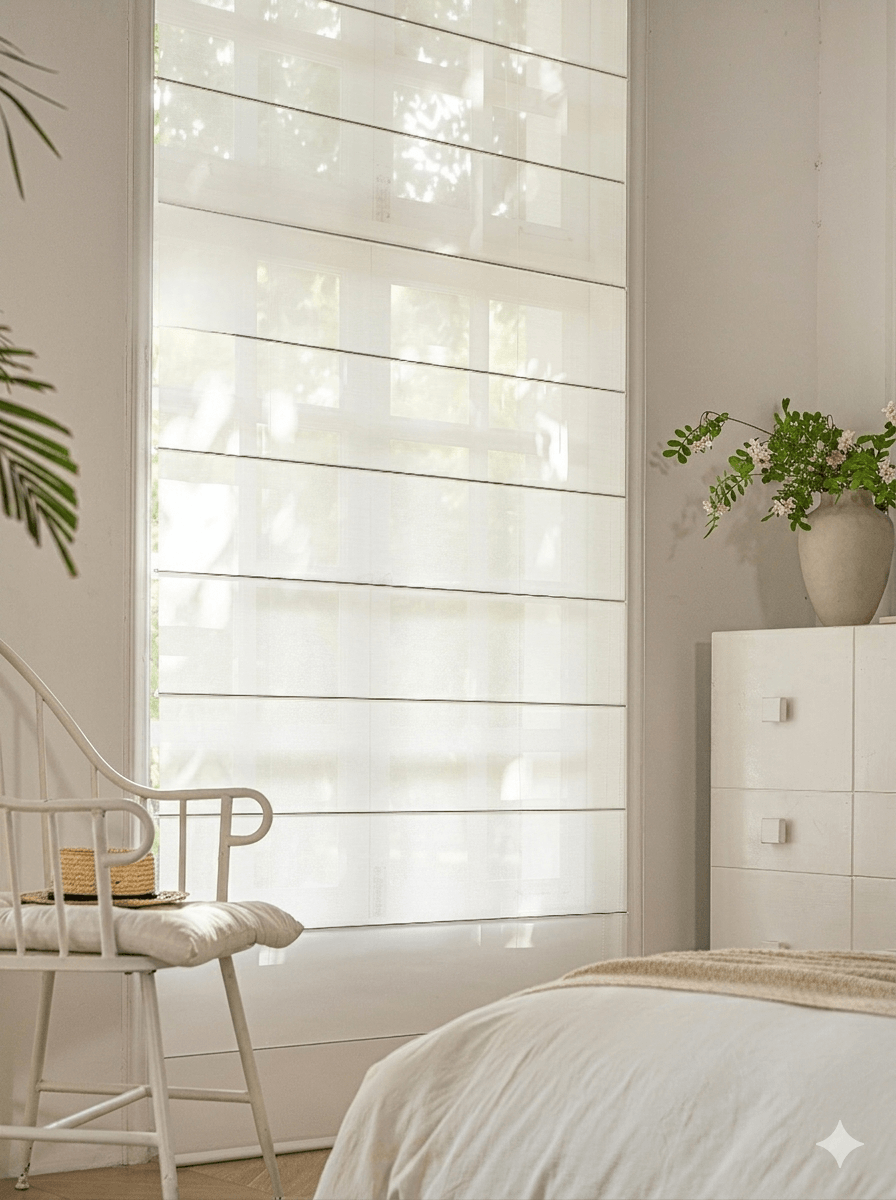
The Lumière listing identifies a weighted bottom hem, a vertical lift handle, and bead-chain control. The live product image shows a white shade with horizontal fold lines lowered across a bedroom window while daylight remains visible through the material. These details help explain its combination of textile softness and visual order without establishing a universal Roman shade specification.
The collection is intentionally focused
The current LuxVelum Roman Shades collection contains the active Lumière product and describes a fine linen-like weave made to measure for light and privacy control. Review the exact listing for current options rather than assuming that a broader shades and blinds collection description applies to it.
Match Roman shades to the room
Living rooms benefit from fabric without side stack
A Roman shade can soften a living-room window while leaving nearby wall space open. Consider how the folded stack relates to the top of the view and whether the fabric should blend with the wall or become a visible design element. If glare changes through the day, test how often the shade needs to move.
Bedrooms require a candid light and privacy check
A softly glowing Roman shade may create a calm daytime atmosphere, but it should not be treated as blackout or room-darkening unless the exact material is labeled accordingly. Observe early daylight, exterior lights, and nighttime sightlines. The room-by-room guide can help rank these needs.
Choose the mount, operation, and measurements
Decide the mount before measuring
An inside mount places the treatment within the opening for a recessed appearance. An outside mount positions it beyond the opening and can provide broader surrounding coverage. Clear depth, trim, handles, nearby surfaces, and the intended raised stack all matter. Compare the tradeoffs in the inside-mount versus outside-mount guide.
Plan for comfortable daily operation
Consider the window height, nearby furniture, control side, and how frequently the shade will move. Confirm the operating method offered for the exact configuration. Do not assume that a control shown on one Roman shade is available across the category.
Measure for the selected product
Record the real opening and mounting surfaces, note obstructions, and keep raw measurements separate from order dimensions. Follow the current product instructions instead of borrowing deductions from a roller shade, blind, or another Roman system. Use the custom window-treatment measuring sequence as a preparation guide.
A practical Roman shade selection process
Start with function
Name the room’s primary need: soft daylight, stronger dimming, nighttime privacy, glare control, compact fabric coverage, or decorative texture. Rank a secondary need so the final decision is not driven by photography alone.
Verify material and fold appearance
Confirm the fiber description, opacity language, color, texture, and how the shade looks both raised and lowered. Ask for clarification when poetic marketing language does not map to a clear light-control category.
Confirm mount, control, and order details together
Review product, material, color, mount, control side, dimensions, quantity, and room label in one final check. A beautiful fabric cannot correct an unsuitable mount or inaccurate order dimensions.
Common Roman shade mistakes
Assuming every Roman shade is light-filtering
Roman construction can use materials with different opacity. Verify whether the exact option is blackout, room-darkening, light-filtering, or sheer.
Expecting folds to look identical in every fabric
Texture, weight, construction, and use affect how folds sit. Review imagery for the exact product and expect a textile treatment rather than a rigid surface.
Ignoring the raised stack
The fabric gathers near the top when raised. Consider how that stack relates to the view, frame, and nearby architectural details.
Making privacy assumptions from daytime photos
Bright exterior light can conceal what nighttime interior lighting reveals. Evaluate the intended material under changing conditions.
Measuring before choosing the mount
Inside and outside mounts use different reference areas. Select the product and mount first, then follow the current measuring instructions.
Roman shade FAQs
Are Roman shades curtains or shades?
They are shades. They use fabric, but they raise and lower over the opening rather than drawing to the sides like curtain panels.
Do Roman shades block all light?
Not automatically. Light control depends on the exact material, while edge light depends on mount, coverage, hardware, fit, opening, and installation.
Can Roman shades provide nighttime privacy?
They can provide coverage when lowered, but privacy varies with material opacity, edge gaps, exterior sightlines, and interior lighting. Evaluate the exact option after dark.
What is the main style advantage of Roman shades?
They add visible fabric texture and horizontal folds while keeping the treatment concentrated at the window rather than stacking along the sides.
Should Roman shades be inside- or outside-mounted?
Choose an inside mount for a recessed look when the opening suits the exact hardware. Consider an outside mount when broader coverage or a different relationship to the trim is more important.
Choose softness with verified structure
Roman shades are a strong choice when you want a fabric-forward window treatment with a compact, structured profile. Compare the exact material and privacy behavior, study the folds in both raised and lowered positions, choose the mount before measuring, and keep product-specific details attached to the product that supports them. That sequence turns a visually appealing shade into a well-matched part of the room.