What Are Jacquard Curtains? A Guide to Pattern, Texture and Drape
Jacquard curtains are curtains with a pattern created through the fabric's woven structure rather than added only as a surface print. That construction can give the design more visual depth, texture, and definition, but the word jacquard does not by itself tell you how soft, heavy, opaque, or light-blocking a curtain will be. Those qualities depend on the exact fibers, weave, layers, finish, and installation.
The best way to choose jacquard curtains is to evaluate the pattern scale, color contrast, surface texture, drape, and verified light-control description as separate criteria. Then confirm the current product details, images, sizing options, and header choices before ordering.
What does jacquard mean in curtains?
In a jacquard fabric, the motif is formed as the fabric is woven. Look closely and you may see the pattern expressed through changes in yarn direction, color, texture, or raised and recessed areas. This differs from a design that is simply printed onto an otherwise uniform woven surface.
Jacquard describes a method of creating the pattern, not one universal look. A motif can be tonal and quiet, high-contrast and graphic, botanical, geometric, or traditionally inspired. The current Luxvelum jacquard curtains collection, for example, focuses on woven patterns that add dimension and detail, but every product still needs to be reviewed on its own.
Pattern is part of the woven surface
Because the motif is integrated into the weave, it can remain visible through both color and texture. Directional light may emphasize raised yarns or subtle changes in the surface, so the same curtain can look quieter from across the room and more detailed at close range.
Jacquard is not a fiber name
Do not treat jacquard as a material such as polyester, cotton, or linen. It identifies how a pattern is woven. Fiber content and construction vary by product and influence the hand, care needs, and way the curtain hangs. Read the specific listing instead of assigning one material profile to the entire category.
Jacquard is not a light-control rating
A woven motif does not automatically make a curtain sheer, light-filtering, room-darkening, or blackout. Density, layers, color, coverage, and installation all affect the result. Use the exact performance language supplied for the product you are considering.
Why choose jacquard curtains?
Jacquard works well when you want the window treatment to contribute more than a flat field of color. The woven design can add depth without requiring a bold printed image, and it can connect solid furniture, rugs, wall color, and smaller decorative accents.
Texture that rewards a closer look
A tonal jacquard can read as restrained from a distance while revealing a more tactile pattern nearby. This makes it useful in rooms where you want visual interest without making every surface compete for attention.
Pattern with adjustable visual weight
Low-contrast motifs tend to feel calmer, while strong contrast makes the curtain more prominent. Pattern scale matters too: a large botanical design can become a focal point, while a smaller repeated motif may act more like background texture.
A more dimensional drape
The woven construction may give a jacquard curtain a structured or substantial appearance, but drape is product-specific. Yarn type, thickness, layers, header, panel width, and fullness all change how folds form. Review both the room view and close-up image rather than predicting the finished result from the category name alone.
How to evaluate pattern, texture, and drape
Start with pattern scale
Compare the motif with the size of the window and the viewing distance. A broad pattern needs enough visible fabric for its rhythm to read. On a narrow opening or behind furniture, parts of the design may be hidden. A tighter repeat can appear more continuous when the panels are gathered.
Compare color contrast
Decide whether you want the pattern to lead the room or quietly support it. High contrast attracts attention and can frame the window as a decorative feature. Tonal contrast emphasizes texture and is often easier to combine with other patterns. Remember that screens and room lighting can affect how colors appear.
Inspect close-ups and room views
A room photograph shows scale and overall mood; a close-up shows yarn detail, raised areas, edges, and trim. Use both. If a listing includes multiple colors, inspect the selected color rather than assuming the motif has identical contrast across every option.
Plan fullness and length with the fabric
Gathering changes how much of the motif is visible at once. Deep folds can make a pattern alternate between highlight and shadow, while a flatter arrangement shows more of the repeat. Use the separate guide to curtain fullness to plan coverage without applying one universal multiplier.
Length also changes the impression of the fabric. A tailored floor treatment, a slight break, and a decorative puddle create different amounts of movement and formality. Review the curtain length guide, then measure from the actual hardware reference to your chosen finished endpoint.
Two current Luxvelum jacquard examples
These products illustrate why jacquard should be assessed listing by listing. Their attributes overlap, but they are not interchangeable and should not be used to make claims about every jacquard curtain.
Bali Botanica: graphic botanical texture
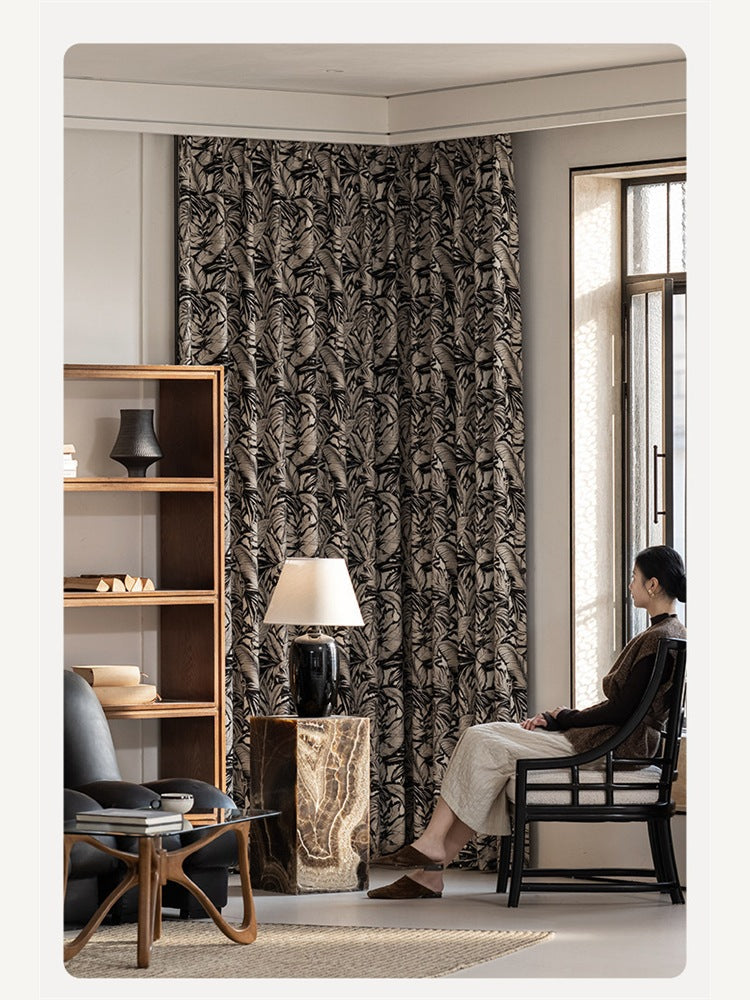
The current Bali Botanica Black Yarn-Dyed Jacquard Custom Curtain has a black botanical motif on a warm-neutral woven ground. Its listing describes yarn-dyed jacquard, dimensional cut-pile leaf details, dense polyester construction, a structured drape, and room-darkening light control. This combination makes the motif and tactile surface central to the design.
Room-darkening is the accurate term for Bali Botanica. The product page notes that the installed result varies with curtain dimensions, fullness, installation, lining, and surrounding light; it does not promise complete blackout.
Maupassant: tonal chenille jacquard
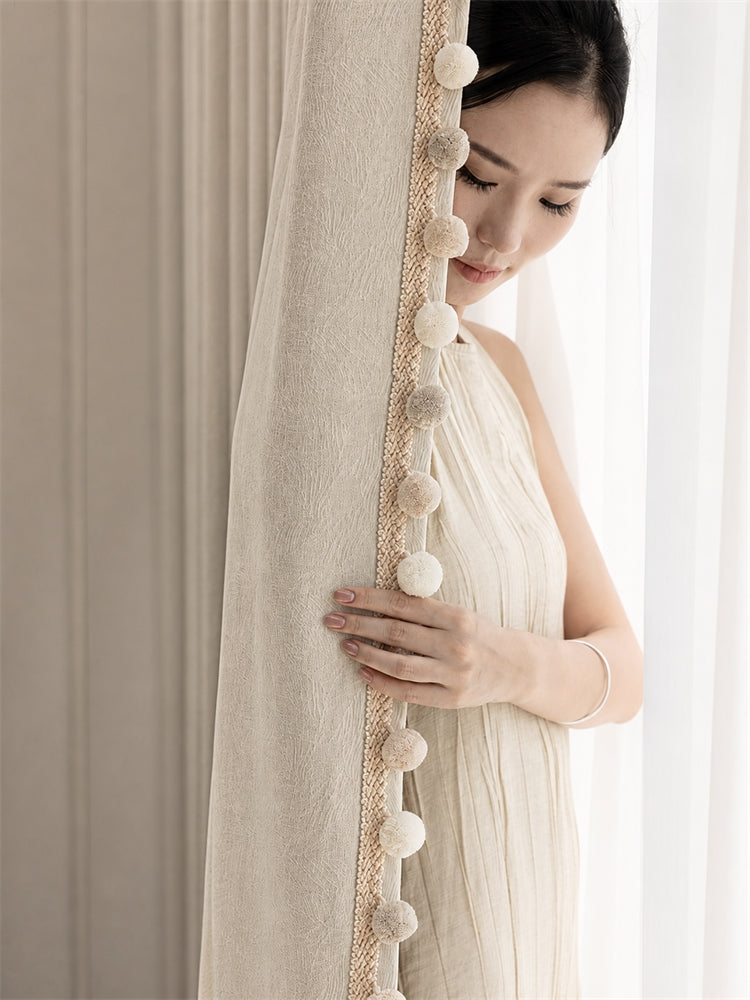
The current Maupassant Reversible Chenille Jacquard Room-Darkening Curtain combines a tonal leaf-inspired motif with reversible chenille construction. Its listing also identifies a substantial drape, layered woven construction, braided edging, plush pom-pom trim, and room-darkening performance.
Chenille and jacquard describe different aspects of this product: chenille relates to its soft, dimensional yarn character, while jacquard describes the woven pattern. Those details belong to Maupassant and should not be transferred to Bali Botanica or to the broader collection. For a closer look at softness, light-control labels, selection, and maintenance, read our guide to chenille curtains.
Choose the right jacquard curtain for the room
Define function before decoration
List the room's priorities: daytime light, evening privacy, decorative impact, daily operation, and layering. If reduced incoming light matters, verify whether the exact product is described as room-darkening or blackout. The guide to light-control terminology explains why those labels are not interchangeable.
Coordinate, rather than duplicate, other patterns
When a rug, wall covering, or upholstered piece already has a strong motif, a tonal jacquard may provide texture without introducing another dominant image. In a simpler room, a higher-contrast botanical pattern can become the focal point. Compare scale, not just color.
Confirm the installation plan
Decide where the rod or track will sit, how the curtains will open, and where the fabric will stack. Check for nearby doors, handles, vents, furniture, and built-ins. Then follow the current measuring and ordering fields for the selected product and header. The custom curtains buyer's guide provides the broader purchasing sequence.
Common mistakes when buying jacquard curtains
Assuming every jacquard is heavy or opaque
Jacquard identifies the woven pattern method, not one weight or opacity. Check the exact construction and light-control description.
Judging the pattern from a close-up alone
A detail image can reveal texture but hide the overall repeat. Pair it with a full panel or room view so you understand scale.
Ignoring how folds change the motif
Fullness and header style affect which parts of the design face forward and which recede into folds. Plan them with the pattern, not after choosing it.
Using room-darkening and blackout as synonyms
Both featured examples are currently described as room-darkening. Do not upgrade that wording to blackout or assume the weave eliminates light gaps around the installation.
Generalizing one product's details
Cut-pile leaves belong to Bali Botanica; reversible chenille and pom-pom trim belong to Maupassant. A category label never replaces the current product specification.
Frequently asked questions
Are jacquard curtains printed?
The defining pattern is created in the weave rather than added only as a surface print. A particular finished fabric may have other treatments, so verify the exact product if that distinction matters to you.
Are jacquard curtains always room-darkening?
No. Light control depends on the specific fabric and installation. Bali Botanica and Maupassant are currently described as room-darkening, but that does not establish a rule for all jacquard curtains.
What is the difference between jacquard and chenille?
Jacquard describes how the pattern is woven. Chenille refers to a yarn and fabric character associated with a soft, textured hand. One curtain, such as Maupassant, can be both chenille and jacquard.
Do jacquard curtains need special fullness?
There is no single fullness rule for all jacquards. Consider pattern scale, header, fabric behavior, desired folds, and the seller's order-width definition for the exact product.
How should I choose between tonal and high-contrast jacquard?
Choose tonal patterning when you want quieter texture and easier coordination. Choose stronger contrast when the window should act as a focal point. In both cases, compare the motif with other patterns and view it at room scale.
A practical jacquard-curtain checklist
- Define the room's light, privacy, operation, and design priorities.
- Compare motif scale and color contrast in full views and close-ups.
- Verify the exact fibers, construction, light-control term, and decorative details.
- Plan hardware, stack space, fullness, and finished length together.
- Measure and order according to the selected product and header.
Jacquard curtains are most successful when woven pattern, texture, and practical performance are evaluated separately and then brought back into one room plan. Start with verified product facts, use imagery to understand scale and surface, and let the installation support the way the fabric is meant to hang.